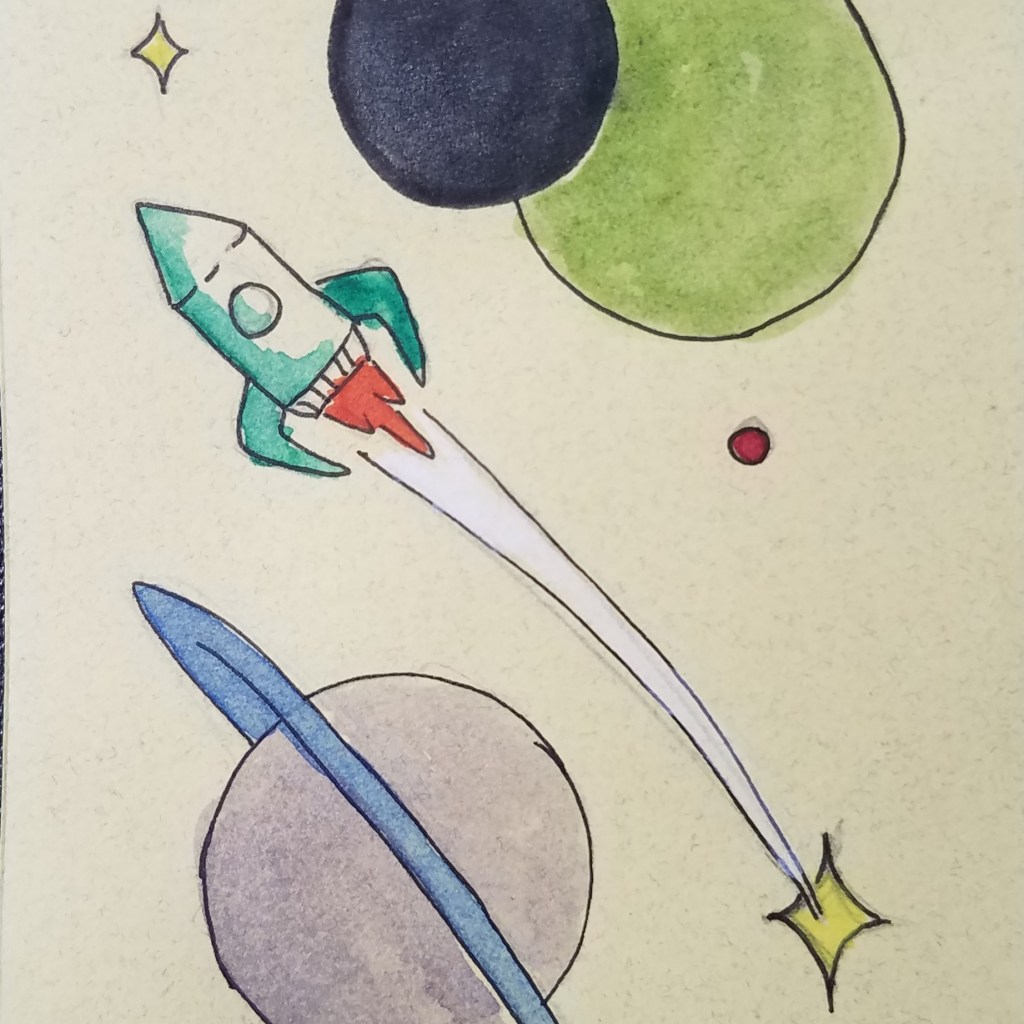
The air was dense here, and heavily saturated with moisture from all of the rich vegetation. All of the growth created a thick canopy that blocked out a majority of the intense sunlight. Kasper and his team had been on planet for 19 hours now, and there had been no visible change in the amount of light that was drifting through the branches.
Since they found no civilization within the first few kilometers of the portal, Kasper opted to set up a base camp nearby for temporary use. They had logged pictures and descriptions of multiple birds and seen a species of megafauna on their initial patrol that had left the entire team so awestruck they didn’t think to get a picture of it until it was almost out of sight in the brush. The drone devices they had sent up above the vegetation had yet to report anything other than a sea of green and mild radiation from the intensity of the light.
Kasper looked over his team as they checked their equipment and made notes in their logs. Behind one of the field scientists, Sanford, there was the shimmer of the portal that they had all come through. A small ring of yellow flags denoted the area around the portal as there was no on/off switch for this natural phenomenon. They simply relied on the might of the compound on the other side to keep anything unwanted out of their world.
Looking back at his notes, Kasper wondered if they had gotten the wrong initial report. The preliminary drones had said the planet was stuck in a prolonged night that left it in perpetual darkness, thus the name “Onyxdrift.” It was hypothesized to be in perpetual night because it had no sun, or saw very little of it. Yet now, Kasper’s team was getting the opposite information. According to the measurements of the drones above the canopy, the bright star that served as the sun of this planet was moving at an incredibly slow pace, so slow they calculated that the “daylight” would last them for months.
As he thought about it, Kasper realized that if the days here could last for several months, it was entirely possible that the nights did as well. If that was the case, Kasper figured they might as well make the most of the daylight and called over Sanford and a botanist, Abramo, so he could accompany them to start collecting the samples they were asking for. He left orders with the rest of the team for a rotating patrol around the perimeter of the camp and that he would take the two scientists in the direction of magnetic north. If they didn’t return in two hours, send a search party.
It was a slow and tedious hike, stopping every few meters for one or both scientists to collect samples, notes, and photographs of various things. Sanford pointed out different insects while Abramo talked about how impressive the plant life was until both fell silent as all three realized they had stumbled upon one of the megafauna.
 Paper and Rabbits
Leave a comment